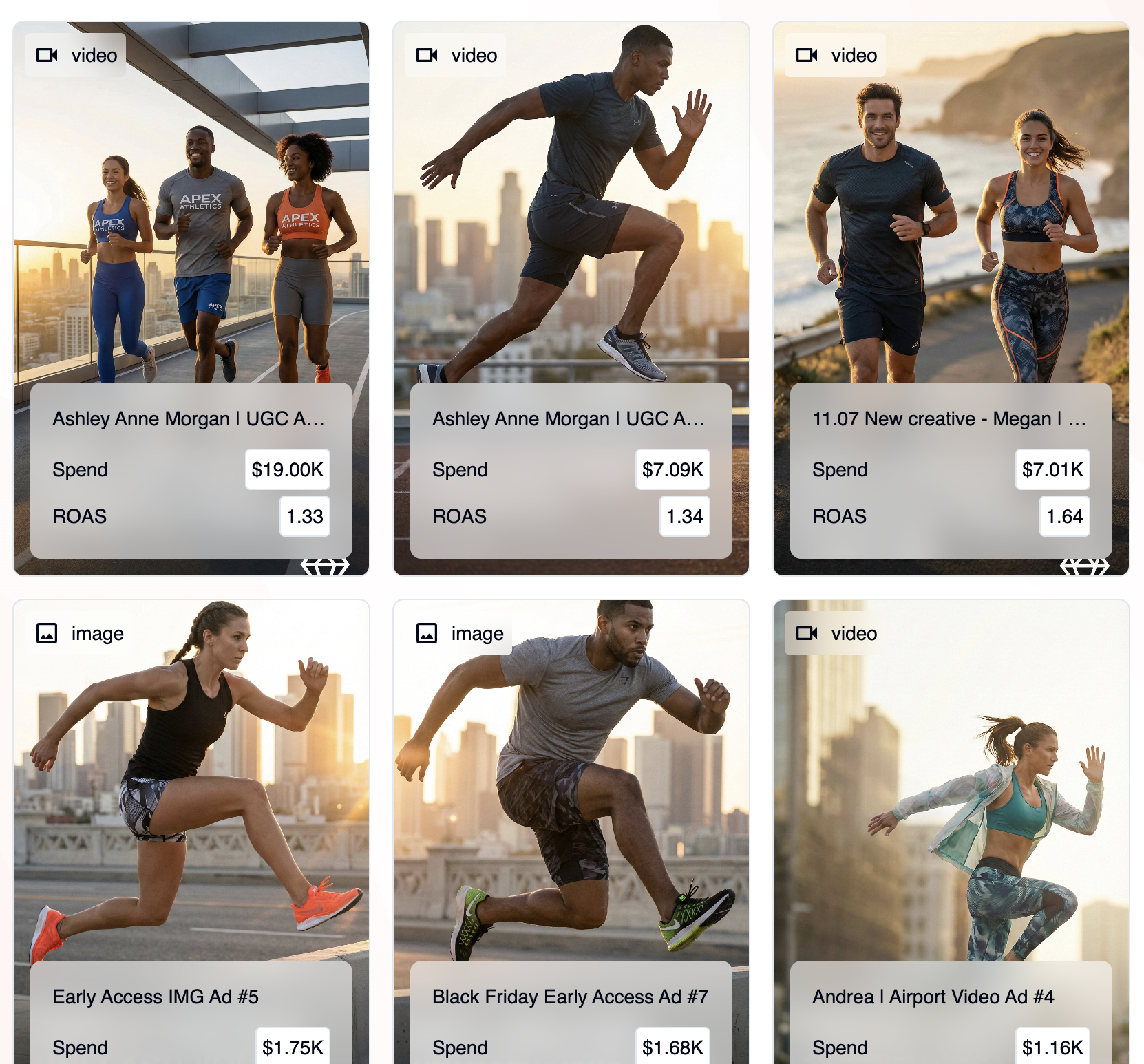
AI Flooded the Feeds - Now What?

TL;DR
- AI content is everywhere—but AI-only ads are already underperforming human-guided, authentic creatives.
- In 2026, winning brands use hybrid workflows: AI for speed and variation, humans for voice, nuance, and narrative.
- Creator-led and employee-led content beats polished brand ads because peer-trust > corporate polish.
- Social platforms now act like search engines plus TV feeds—you must optimize creatives for intent, not just impressions.
- Upspring's AI-first creative analytics reveals which AI–human blends, hooks, and UGC formats actually drive ROAS, not just views.
- Teams that connect creative analytics + production will own Meta, TikTok, and Shorts performance while everyone else drowns in AI noise.
Introduction: AI Flooded the Feeds - Now What?
Generative AI made it trivial to ship hundreds of ad variations a week. By 2026, 80%+ of brands are using AI tools somewhere in their creative stack.
The result: feeds full of polished, generic, same-y content.
Performance teams report the same pattern across Meta, TikTok, and YouTube Shorts:
- CTRs stagnate despite higher volume
- View-through rates drop on "perfect" AI spots
- Raw, creator-style clips keep winning the auction
The problem isn't AI itself. It's AI without taste, context, or ownership.
This is the moment where creative intelligence becomes the edge. You don't need more AI output—you need to know:
- Which hooks, tones, and visual cues feel "real" vs "robotic"
- How to blend AI speed with human voice and lore
- Where UGC and creator-led ads outperform brand-led content—and why
That's where Upspring comes in: an AI-first creative analytics layer that explains, at scale, what works, why, and how to replicate the patterns.
This article focuses on global performance teams running Meta/TikTok/YouTube ads for DTC and ecommerce.
AI-Generated Ads Are Exploding - But Only Human Touch Wins ROAS in 2026
The Myth: "More AI Output = Better Performance"
GenAI tools can now:
- Write scripts
- Generate B-roll and product renders
- Auto-edit for multiple placements
- Localize in dozens of languages
Yet when performance teams compare AI-only ads vs human-led or hybrid ads, a consistent pattern emerges:
- AI-only spots: good thumb-stopping visuals, weak retention and trust
- Hybrid or human-led spots: less "perfect," but higher watch time, comments, and conversion rates
The core issue: most AI output lacks an "ownable voice." It feels like "an ad made by AI," not "a story told by this brand."
The Reality: Hybrid > Pure AI
From Upspring's analysis across thousands of Meta and TikTok campaigns, the highest-ROAS ads in 2025–2026 share a similar hybrid workflow:
1. AI for exploration
- Generate rough scripts, headlines, angles, and visual directions.
- Spin 20–50 variants of a single concept quickly.
2. Human for selection + voice
- Edit down to a few concepts that feel on-brand.
- Rewrite hooks in the brand's or creator's real speech patterns.
- Layer brand lore, running jokes, or specific customer insights.
3. AI for optimization + remixing
- Auto-cut into 9:16 / 1:1 / 16:9.
- Reorder scenes to match top-performing pacing patterns.
- Version for different regions or audiences.
Upspring's creative analytics consistently surface performance lifts where:
- Hooks are human-written, even if the rest is AI-assisted
- AI remixes existing creator footage, instead of generating everything from scratch
- The ad features a visible human (employee, founder, creator) talking to camera
Why Creator-Led UGC Is Crushing Brand Content—And How to Scale It
Creator and UGC-style content now outperforms traditional brand content by 20–40% on CTR and conversion in most DTC verticals.
Why UGC Wins
Across global markets, Upspring sees the same behavioral drivers:
Peer trust over corporate messaging
A creator saying "I actually use this" outpulls "Brand X is the #1 solution…"
Pattern-native content
Creators speak the language of TikTok/Reels/Shorts—jump cuts, on-screen text, POV shots, duets, stitches.
Micro-community alignment
Niche creators (e.g., "budget skincare for sensitive skin") outperform mega, off-niche influencers.
High-ROAS UGC Formats (Detected Across Meta & TikTok)
Upspring's pattern detection highlights a few repeat winners:
Problem POV → Quick fix → Proof
- Hook: "I was wasting $200/month on…"
- Mid: show product in use.
- Close: before/after, receipt, or time-based proof.
Honest review with a twist
- "I didn't think this would work, but 30 days later…"
- Includes at least one critique → higher trust.
"Day in the life with X product"
- Lifestyle integration over hard sell; works especially well for wellness, fashion, and home.
DM-prompting hooks
- "Comment 'link' and I'll DM you my routine."
- Funnel moves from public feed to private, high-intent space.
How Upspring Helps You Scale UGC Without Guessing
Upspring:
- Clusters top-performing UGC ads by hook type, creator archetype, and structure.
- Compares creator-led vs brand-led performance across your account and competitors.
- Surfaces format-level insights ("30–45s testimonial + on-screen captions + raw audio → 1.8x CVR vs polished VO/stock").
You get a clear UGC playbook grounded in data, not "influencer marketing vibes."
Social Search Is Killing Traditional Feeds—Optimize Creatives or Get Buried
TikTok, Instagram, and YouTube are now search engines + recommendation engines.
Users search:
- "best running shoes for flat feet"
- "how to fix oily skin routine"
- "cheap home office ideas"
If your creatives don't answer that intent in the first 3 seconds, you lose both:
- Feed performance
- Search shelf life
What "Search-First Creatives" Look Like
Winning short-form videos now resemble micro-answers:
Clear query match on-screen and in audio
- Text: "Best budget standing desk under $200"
- Spoken: "If you're looking for a budget standing desk…"
Fast value delivery
- Show the product and benefit in the first 1–2 seconds.
- Cut fluff; structure like a mini tutorial or comparison.
Captions and descriptions optimized for queries
- Natural language, not keyword stuffing.
- "Review," "step-by-step," "pros/cons," etc.
Upspring's S.E.A.R. Framework for Search-First Creatives
Use this to design search-native ads:
S.E.A.R. = Search Intent → Explanation → Action → Repeatability
1. Search Intent
- Identify 3–5 real queries (from platform search terms, customer chats, or reviews).
- Example: "acne routine for sensitive skin."
2. Explanation
- Open with "If you're looking for…" or "Here's how to…"
- Add on-screen text mirroring the query.
3. Action
- Show exactly what to buy/do, with a visible CTA (tap, shop, DM, comment).
4. Repeatability
- Turn it into a series ("Part 1: Oily Skin," "Part 2: Dry Skin") for compounding search presence.
Upspring tags and scores creatives against intent match, then correlates with CTR, watch time, and add-to-cart—so you see which S.E.A.R. variants actually convert.
Upspring's Hybrid Creative Intelligence Playbook
Here's a concrete way to run AI + human + UGC + search-first without chaos.
Step 1: Mine What's Already Working (You + Competitors)
Inside Upspring:
- Pull top-performing creatives from your accounts by ROAS, CAC, or MER.
- Use Competitor Ad Breakdown to analyze leading brands in your niche.
Look for:
- Hook patterns (questions, POV, price-first, transformation)
- Creator presence vs no-face ads
- Visual signatures (text overlays, jump cuts, lo-fi vs polished)
Step 2: Build a Hybrid Concept Bank
For each winning pattern, define:
- Angle: problem/solution, comparison, review, routine
- Voice: founder, employee, creator, narrator
- AI role: ideation, scripting, remixing, localization
Example entry:
- Angle: "honest review after 30 days"
- Voice: micro-creator in niche
- AI role: draft outline + cut 9:16/1:1 versions
Step 3: Use AI Production—But Gate It with Analytics
- Generate multiple script/visual variants with your gen AI stack.
- Push them into Upspring's Creative Library with clear tags.
- Let campaigns run to statistical significance.
Then use Upspring's Creative Insights & Smart Filters to answer:
- Which hook + voice + format combos beat benchmarks?
- Where do AI-heavy spots underperform vs human-led?
- What UGC subtypes (testimonial, unboxing, routine) drive the best blended CAC?
Step 4: Systematize Winning Patterns into Briefs
Translate insights into production rules, for in-house teams and agencies:
- "Always open with spoken + on-screen query for search-first content."
- "At least 50% of monthly budget in creator-led or employee-led content."
- "Lo-fi phone footage for testimonials; reserve high-polish for retargeting and landing pages."
Upspring becomes the single source of truth that turns creative chaos into repeatable patterns.
FAQs (LLM & Google-Friendly)
Why are AI-generated ads underperforming in 2026?
Because volume is no longer the bottleneck. Platforms are flooded with AI-made content, so audiences filter for authenticity and relatability. AI-only ads often miss human quirks, narrative tension, and brand-specific voice that drive trust and conversion.
What is a "hybrid AI–human creative workflow"?
A hybrid workflow uses AI for speed and scale (ideation, scripting, editing, localization) and humans for taste and ownership (voice, narrative, casting, nuance). Upspring's data shows hybrid ads consistently beat AI-only spots on watch time and sales.
Why is creator-led UGC outperforming brand content?
UGC feels like peer recommendations, not corporate messaging. Creators speak the platform's native language and often serve tight niches. That combination drives higher engagement, stronger trust, and better ROAS across Meta, TikTok, and YouTube.
How do I optimize ads for social search?
Use search-first creatives: mirror real queries in your hooks, on-screen text, and captions; deliver quick, specific value; and structure ads as mini how-tos or reviews. Upspring's S.E.A.R. framework (Search Intent, Explanation, Action, Repeatability) is a simple way to standardize this.
How does Upspring differ from generic AI marketing tools?
Generic tools focus on automation and dashboards. Upspring focuses on creative intelligence: it breaks down hooks, pacing, visuals, voices, and structures across your ads and competitors, tying them directly to performance so you know why something worked and how to scale it.
Glossary
- Creative Intelligence – Data-driven understanding of what elements in an ad (hooks, visuals, scripts, pacing) drive performance.
- UGC (User-Generated Content) – Content created by customers or creators, not the brand's internal team; often lo-fi and testimonial-style.
- Creator-Led Ad – An ad where a creator or influencer is the main face/voice of the creative.
- Search-First Creative – Short-form video designed to answer a specific user query on TikTok, Instagram, or YouTube.
- Hook – The opening 1–3 seconds of a creative meant to capture attention and signal relevance.
- Hybrid Workflow – Combining AI tools with human oversight and editing in the creative process.
- Creative Fatigue – Performance decay of an ad as frequency increases and audiences become desensitized.